
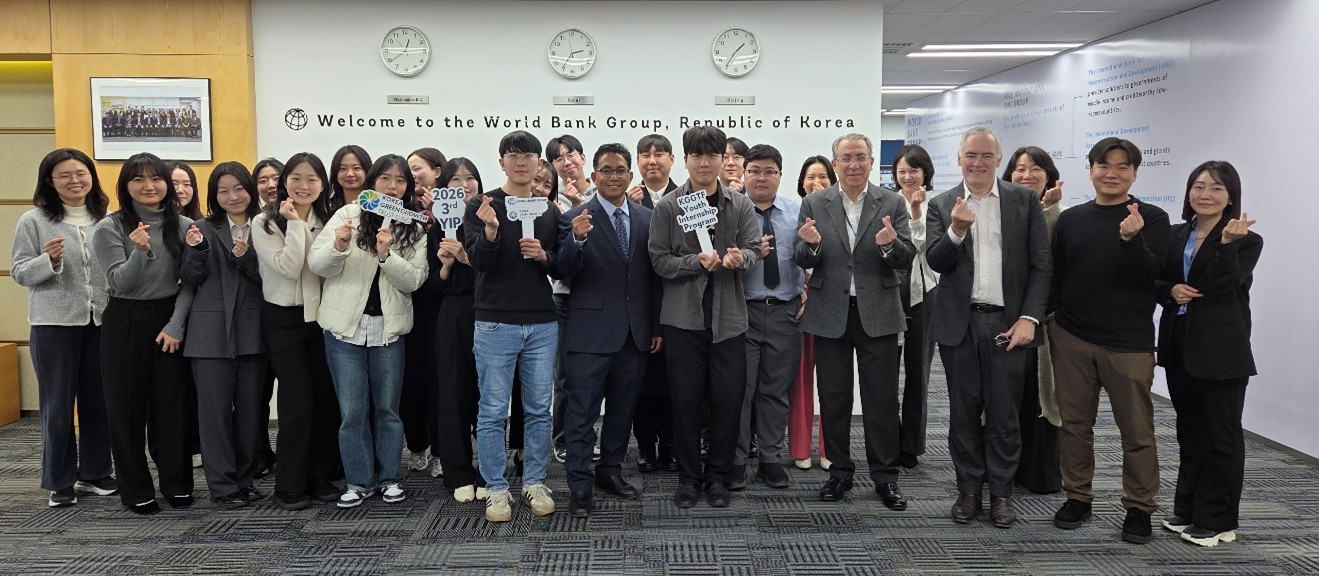
By: Sungbin Na, Jihye Kang, and Seungwoo Yoo, KGGTF 2026 Youth Interns
On January 27, 2026, the KGGTF Youth Internship Program hosted a career talk and lecture by Jason Allford, Country Manager of the World Bank Korea Office. Drawing on Korea’s development trajectory and his professional experience, the session explored how countries can overcome structural barriers to development and offered guidance for young professionals preparing for careers in international development.
Mr. Allford outlined Korea’s development path from early investments in education and basic manufacturing to industrial upgrading, infrastructure expansion, and skills formation. He emphasized that Korea’s experience is not a universal model but a source of adaptable lessons that can be selectively applied depending on country context. A key role of the World Bank Korea Office, he noted, is converting Korea’s development experience into practical knowledge that can support other countries—particularly where public policy and private investment must work hand in hand.
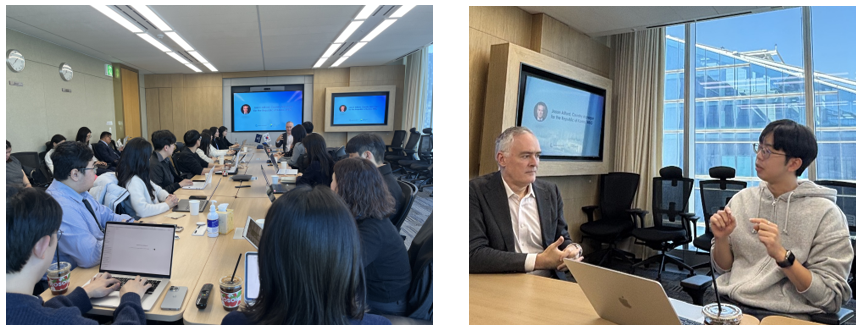
He highlighted the importance of mobilizing private capital alongside public development finance, pointing to institutions such as MIGA that help de‑risk investment and enable private sector participation. Korea’s strong institutional support and willingness to share its development knowledge, he added, make it a meaningful partner in global development cooperation. Korea’s technological strengths also offer relevant insights for countries seeking to address persistent constraints through innovation and targeted investment.
Reflecting on career development, Mr. Allford encouraged interns not to shy away from specialization, stressing that depth of expertise is essential in development work. At the same time, he advised maintaining flexibility and openness to unexpected opportunities. Success in development, he suggested, requires both strategic focus and the ability to adapt to evolving challenges at national and individual levels.
Technical Lecture by Danilo Antonio, Land and Geospatial Specialist
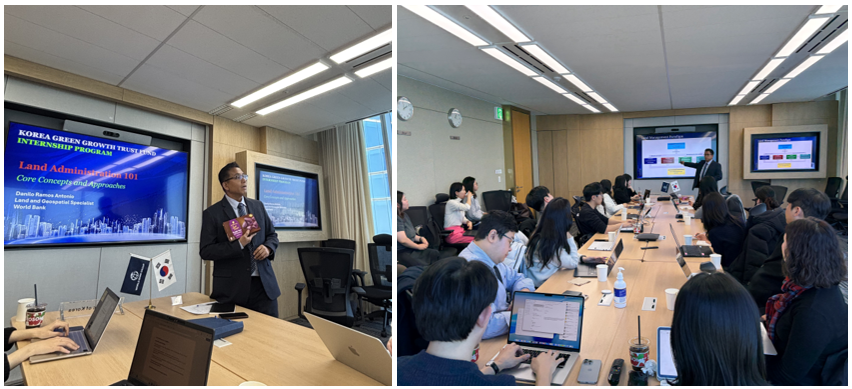
Next was a technical session led by Danilo Antonio, Land and Geospatial Specialist at the World Bank. Drawing on extensive field experience, he emphasized the importance of pragmatic land governance and provided guidance on navigating its technical and institutional complexities.
Mr. Antonio traced the evolution of land systems and noted that Korea’s advanced e‑government and digital land titling systems, while exemplary, are not always feasible models for developing countries. Many nations face severe cost and capacity constraints that make rapid adoption of Digital Twins, AI‑driven mapping, or full-scale digitalization unrealistic. Instead, he argued, resilient land systems begin with basic, accurate cadastral information and a “fit‑for‑purpose” approach aligned with local feasibility.
He highlighted the value of open‑source GIS software as a cost‑effective alternative to expensive proprietary tools. In resource‑constrained environments, he explained, long‑term sustainability depends on lowering entry barriers and minimizing financial risk. Drawing on examples from Uganda, Nepal, and Indonesia, he demonstrated how satellite imagery and incremental digitalization can strengthen land administration without requiring high-end infrastructure. Land reform, he added, is often contentious and demands human‑centered adjudication and political commitment—technology alone cannot resolve institutional challenges.
On career development, he emphasized that specialization is vital for understanding the technical and legal nuances of land governance, while openness to diverse country contexts is equally important. Effective land management, he concluded, requires strategic focus on essential data and an adaptable approach tailored to each country’s institutional realities.
The WBG Digital and AI Strategy: An Overview
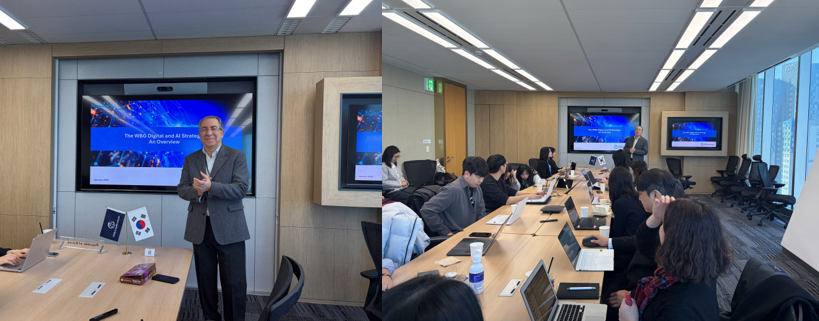
The final lecture was delivered by Zaki Khoury, Senior Digital Development Specialist at the World Bank. He provided an overview of the institution’s digital and AI strategy, emphasizing how digital connectivity has reshaped daily life and development priorities. The Bank’s mission, he explained, focuses on expanding access, affordability, digital ecosystems, and AI readiness.
Khoury noted that while digital transformation holds tremendous potential, its benefits are not evenly distributed. Many countries continue to face gaps in broadband infrastructure, digital literacy, and institutional capacity, which limit their ability to harness emerging technologies. He stressed that closing these gaps requires coordinated investments in infrastructure, inclusive digital policies, and capacity building at both government and community levels.
He also underscored that effective digital development depends on strong data governance frameworks that protect privacy, ensure cybersecurity, and enable responsible use of AI. Without these safeguards, he explained, digital systems risk reinforcing inequalities or exposing vulnerable populations to new forms of exclusion. He highlighted the World Bank’s role in supporting countries as they establish regulatory environments that balance innovation with safety.
Mr. Khoury also highlighted the growing environmental and infrastructure pressures created by rapid data production, noting that data centers generate greenhouse gas emissions comparable to the aviation sector. Addressing these challenges requires close collaboration between digital and energy teams to optimize energy use, improve efficiency, and support greener data practices.
He concluded by encouraging interns to cultivate “T‑shaped” expertise—combining deep technical knowledge with cross‑sector collaboration—and to build their skills diagonally over time through both breadth and depth of experience.